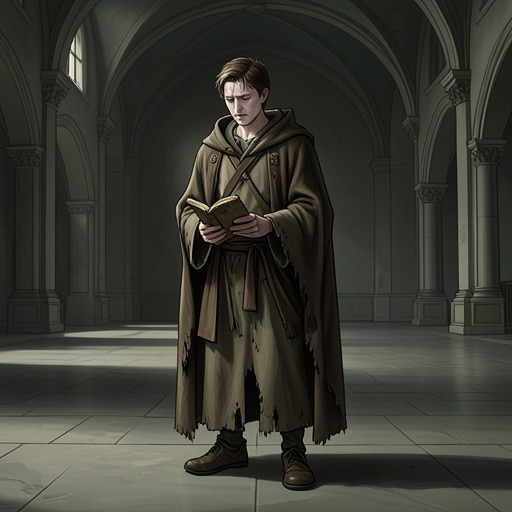
Manfred–Conrad Father-Son Relationship
The Castle of OtrantoManfred–Conrad Father-Son Relationship is a bond shaped by favoritism and dynastic calculation. Manfred dotes on his only son, Conrad, despite the young man’s frail health and unpromising character, while showing little affection to his daughter, Matilda. Yet Conrad’s death reveals that Manfred’s attachment is inseparable from his hopes for the ruling line: the loss of his son is framed not only as bereavement, but as the collapse of a political future he had tried to secure through marriage.
Identity and Background
Manfred, Prince of Otranto, has two children: Matilda, eighteen and described as beautiful, and Conrad, three years younger, sickly and homely. Conrad is his father’s favorite, although Manfred displays no comparable tenderness toward Matilda. This contrast establishes the relationship as unequal within the family, and makes the father’s preference especially striking given Conrad’s physical weakness and lack of promise.
Conrad’s place in the family is also political. Manfred has arranged his marriage to Isabella, daughter of the Marquis of Vicenza. Her guardians have already delivered her into Manfred’s care so that he can celebrate the wedding when Conrad’s health permits. The match is thus not simply a private arrangement: it is intended to join the two houses and strengthen the position of Manfred’s son as the next generation of the ruling family.
The Wedding and Conrad’s Death
The wedding is set for Conrad’s birthday, with the company assembled in the chapel of the Castle. When Conrad is missing, Manfred sends a servant to summon him. The servant returns in alarm and points toward the courtyard, where the assembled company hears cries of shock. The news is conveyed in fragments, with repeated calls about a helmet, before Manfred goes to see what has happened.
Conrad has been killed by an enormous helmet that has fallen upon him. Manfred’s reaction unsettles those who know how much he favored his son. He examines the helmet and remains absorbed by the extraordinary object, paying less attention to Conrad’s death than to the phenomenon that caused it. The family’s grief is therefore interrupted by the supernatural event, while Manfred’s apparent preoccupation makes the relationship’s emotional dimensions difficult to separate from his concern for the succession.
Favoritism and Dynastic Purpose
After Conrad’s death, Manfred tells Isabella that the boy was sickly and that Heaven may have taken him away so that Manfred would not have to entrust the honors of his house to a frail foundation. He even says that he hopes, in time, to have reason to rejoice at Conrad’s death. The words recast his earlier favoritism: although Conrad had been his darling, Manfred now measures the son against the demands of dynastic survival and regards the marriage as a failed means of securing the line.
Manfred’s urgency to marry Isabella himself makes that political calculation explicit. He presents the need for sons as a matter on which his fate depends, repudiates Hippolita, and offers himself to Isabella after Conrad can no longer marry her. The shift from arranging a marriage for his son to proposing himself as Isabella’s husband shows how quickly Manfred redirects the alliance toward his own effort to produce heirs. Conrad’s death does not end the marriage plan’s political purpose; it changes who is meant to benefit from it.
Succession and the Relationship’s Aftermath
Manfred later acknowledges that the proposed marriage between Conrad and Isabella had served his plan to unite the claims of the houses of Otranto and Vicenza. He explains that Conrad’s death helped prompt his decision to marry Isabella himself, while the rival claim to Otranto remained unresolved. The father-son relationship is therefore embedded in a wider conflict over legitimate rule: Conrad is both Manfred’s favored child and the intended instrument of a political settlement that would protect his family’s hold on the principality.
The ending overturns the assumptions under which Manfred had favored Conrad. In his confession, Manfred admits that his own family’s claim rests on Ricardo’s poisoning of Alfonso and a fictitious will. The supernatural judgments and the revelations about Alfonso’s descendants bring that usurpation to light; Manfred accepts that his line has lost its right to rule. He abdicates, and Hippolita joins him in religious life. Conrad’s death, the first great catastrophe of the story, thus anticipates the collapse of the succession Manfred sought to preserve through his son.
Narrative Significance
The relationship makes paternal affection part of the novel’s political machinery. Manfred’s preference for Conrad is real enough to be remarked upon, but its consequences are bound to inheritance, marriage, and the continuation of a ruling house. When Conrad dies on the very day set for his wedding, the event destroys both a family bond and Manfred’s immediate dynastic plan; Manfred’s response exposes how readily his attention turns from the son to the future of the house.
The later revelations sharpen that irony. Manfred’s family has attempted to secure its position through Conrad’s marriage, while its original title derives from a crime against Alfonso. The apparent continuity of father, son, and dynasty proves fragile: Conrad is lost, Manfred’s claim is renounced, and the principality passes to the rightful heir. Their relationship therefore gives the succession conflict its intimate opening form, connecting the personal preference of a father to the political legitimacy of an entire house.